
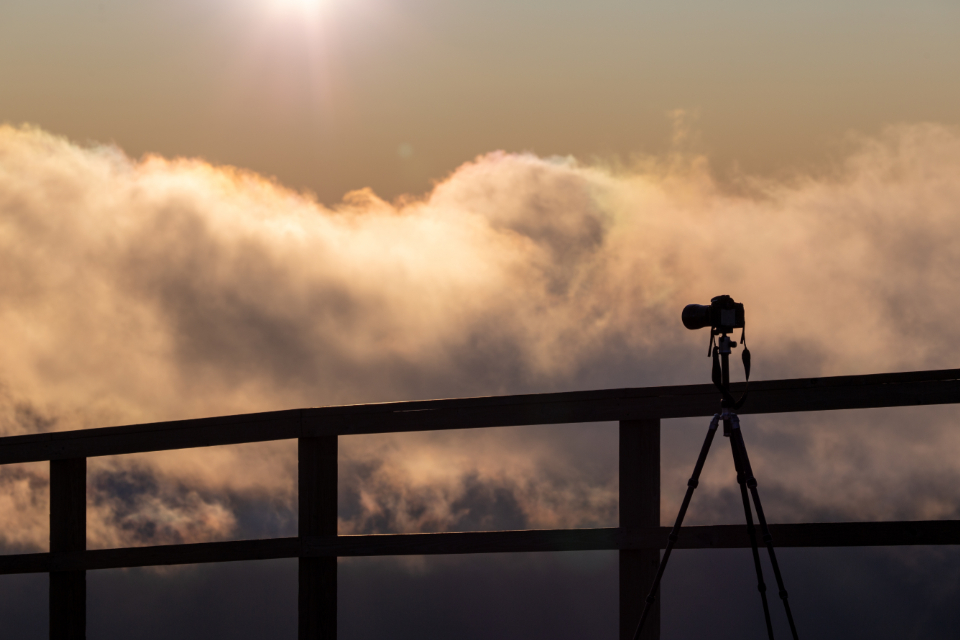
An inefficient way to spend an afternoon
On a good Saturday I will walk for three hours and come home with eleven frames. Sometimes six. A friend who does not photograph asked me once what I did for those three hours and the honest answer was that I stood in four places for a long time and walked between them slowly, and that I would not be able to account for most of the time in any way that sounded like activity.
This is on purpose, and it took me years to arrive at it, and it is the single change to my practice that improved the work most. Not a technique. Not a way of seeing. Just going slower than the situation requires, deliberately, as a standing policy.
How I got fast, and what it cost
I did not start slow. I started the way most people start now, which is fast, because everything about the equipment and the culture around it encourages speed. The machine will make eight frames in a second and will not complain. There is no cost per frame. There is no reason not to work quickly except a reason you have to invent and then enforce on yourself.
For about three years I worked that way and I made an enormous number of photographs. I remember almost none of them. That is the part that eventually bothered me. I would come back from a whole day out with several hundred files, and going through them was a chore rather than a pleasure, and I could not remember standing in most of the places they showed. I had been present at the locations without ever quite being in them.
The pictures had a look too, a look I can spot now in other people’s work immediately. Fast pictures tend to take the first idea a place offers. They are correct and they are unsurprising, because the first idea a place offers is the obvious one, and the obvious one is what everybody gets. The interesting material is under it, and there is no way to get under it in ninety seconds.
The rules I gave myself
Willpower did not work. Deciding to be more thoughtful lasted about twenty minutes into any walk. So I built constraints instead, which are dumber and much more effective.
- No frame in the first fifteen minutes of a walk, whatever happens.
- When I want to photograph something, wait sixty seconds before doing it.
- If I make a frame, stay in the spot for two more minutes afterward.
The first rule fixes the biggest problem, which is that I arrive somewhere carrying the wrong speed from the car and the day, and the first ten minutes of any outing produce pictures made by a person who has not landed yet. The second rule kills roughly half of what I would otherwise photograph, and the half it kills is the half I would have deleted anyway. The third rule is the most valuable and the hardest to keep, because once you have made the frame the pull to move on is enormous, and what is very often true is that the picture you just made was a first draft of a better one available from three feet away.
Standing still for twenty minutes
The extreme version of this, which I do maybe once a month, is to pick a spot and not leave it. Twenty minutes, sometimes forty. No walking. This is uncomfortable in a way that is out of proportion to how simple it is.
What happens is roughly the same every time. The first five minutes are agitated. I catalog the place, decide there is nothing here, and start composing an argument for moving on. Minutes five to ten are worse, a low boredom with a fidgety edge. Then somewhere past ten the place stops being a scene and starts being a location where things happen. Light moves. A door opens somewhere I had not noticed there was a door. A pattern of who walks past and where becomes visible, because it takes that long for a pattern to occur twice.
Almost everything good I have made in the last five years came after minute twelve of standing somewhere. I do not think this is mystical. I think it takes a human being about that long to stop performing the activity of looking and start actually doing it.
Slowness is not the same as care
I want to guard against the easy version of this, because there is a romantic story about slow work that I do not believe and that I have caught myself telling.
Slowness is not a virtue on its own. It is entirely possible to work slowly and thoughtlessly, to stand around for half an hour and then make the same obvious frame you would have made in the first minute, only now with a sense of having earned it. I have done that. The waiting produced nothing except a feeling of seriousness, which is a counterfeit of the real thing and much easier to obtain.
What makes slow work useful is not the duration. It is that the duration creates room for the second and third and fourth ideas, and those ideas only arrive if you are actually still looking during the wait rather than congratulating yourself for waiting. The test is simple and slightly brutal. If the picture I made at minute twenty is the same one available at minute one, the twenty minutes were decoration.
What slow work does to the pictures
The change in the work is not that it became more beautiful. It became more specific.
Fast pictures of my town are pictures of a small southern town, which is a category, and which anyone can supply. The slow ones are about this particular corner, on this particular kind of afternoon, with this particular loose brick and the way the water sits on it. The subject narrows. It gets less impressive and more true, and the tradeoff has been worth it every time.
There is a second effect. Because I make so few frames, I remember making all of them. My archive from the last several years is not a heap of files I have to excavate. It is a few hundred pictures, and I can tell you where I was standing for nearly every one, what the weather was, and usually what I got wrong. That is a working memory rather than a storage problem, and it makes the actual editing something I look forward to instead of a debt.
Keeping the pace when it is inconvenient
The hard part is that the world does not cooperate with any of this. Travel is the worst offender. You have four days somewhere and every instinct screams to cover ground, and covering ground is exactly the thing that produces the fast, generic, first-idea pictures. I have come back from trips with two hundred frames and nothing, and come back from an afternoon on my own street with three things I still like.
People also make it hard. Waiting sixty seconds in front of a building is invisible when you are alone and enormously awkward when someone is standing beside you being patient. I have mostly solved this by working alone, which is a cost. I miss company and I have decided the pace is worth more.
And the pace slips constantly. I catch myself two hours into a walk making frames at a clip, half-looking, and the giveaway is that I am no longer noticing my own feet on the ground. When that happens I stop, put the camera away for ten minutes, and start over. Not as a punishment. It is just that the fast version of me is not a photographer, he is a person operating a device, and the pictures know the difference even when I do not.