
Everyone photographs the depot
There is an old depot building at the center of this town and it may be the single most photographed object within thirty miles. On a Saturday in October you can stand near it and count six or eight people making pictures of it in an hour, phones mostly, occasionally something more serious on a strap. I have photographed it myself, more than once, and I have felt vaguely embarrassed about it every time, and I have never quite been able to explain the embarrassment.
A while ago I decided to stop being embarrassed and get curious instead. I went looking for what everyone else had made of the same building, and of the square, and of the small park with the fountain. There is a lot of it. It is easy to find. And spending time inside that pile of other people’s pictures of my own town turned out to be one of the more useful things I have done for my own work.
Looking at the town through a search field
You can type the name of almost any place into an image search and get a wall of results, and the wall has a structure that becomes obvious after you have stared at it long enough. It is not random. Roughly the same five viewpoints repeat, over and over, made by hundreds of people who mostly did not consult each other.
For our depot the wall is: the three-quarter view from the corner with the tree on the left, the same view in fall color, the head-on symmetrical one, the detail of the lettering on the sign, and a version at sunset with the sky doing something. That is essentially the entire corpus. Change the season and shuffle the order and you have described several thousand photographs.
My first reaction was a kind of superiority, which did not survive contact with my own archive. I went and looked. I have made four of those five pictures. The only one I am missing is the sunset, and I am missing it because I do not like sunsets, not because I found something better.
The consensus picture
What interests me is how the agreement forms in the first place. Nobody organizes it. There is no sign telling you where to stand. And yet hundreds of unconnected people, over years, converge on almost identical positions.
Part of it is physical. There are only so many places you can stand where a tree is not in the way and the building fits. The geometry of a street does most of the work of composing before you arrive. Part of it is inherited, because people have seen the postcard version and are, without quite deciding to, reproducing it. And part of it is that the building genuinely does look better from that corner, and pretending otherwise to be interesting is its own kind of dishonesty.
So the consensus picture is not stupid. It is a solution that hundreds of people independently found to a real problem. Calling it a cliche is accurate and also a bit lazy, because it does not explain why the solution is so stable.
What the repetition is actually saying
Here is the turn I did not expect. Once I stopped judging the pile of similar photographs and started reading it as a single object, it became genuinely informative.
All of those pictures together are a record of what this town has agreed to be proud of. They are a collective statement, unsigned, about which four hundred square feet of a place matter. And what is not in the pile is just as loud. Nobody photographs the road out past the school. Nobody photographs the parking lot behind the row of shops, or the drainage ditch, or the newer streets on the east side where most people actually live. The town in the pictures is about six percent of the town.
That gap is now most of what I work in. Not out of contrarianism, or not only. It is that the depot has been described thoroughly by many capable people and the road past the school has been described by nobody, and if I am going to spend a Saturday I would rather spend it where the record is thin.
The stranger with a phone at the fountain
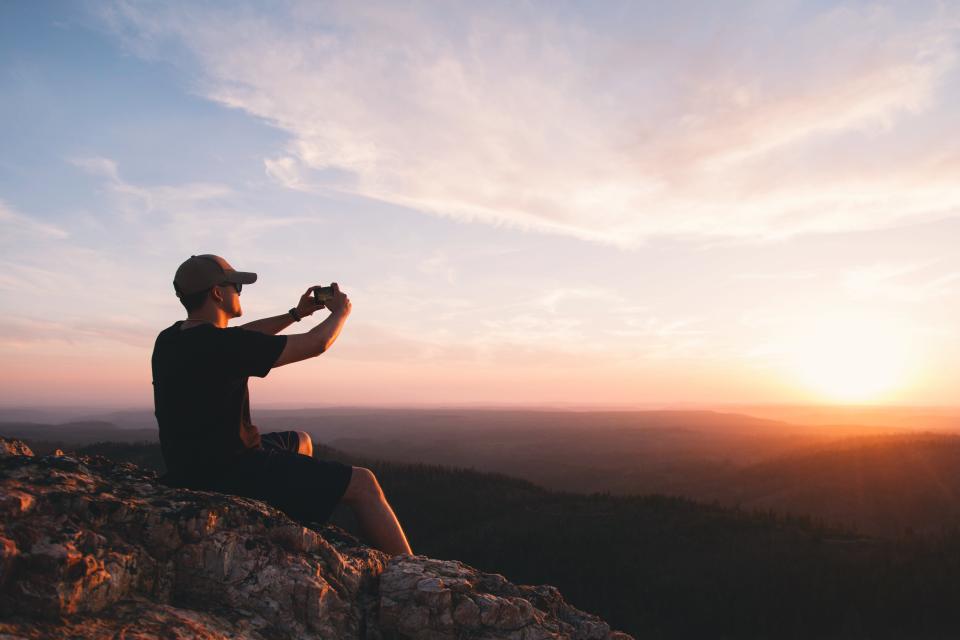
Last spring I watched a woman photograph the fountain in the park for about ten minutes. She was working, in the real sense. She moved four times, crouched once, waited for two children to pass out of the frame and then, when they came back, waited deliberately for them to be exactly where she wanted. She was making the same photograph of the fountain that a great many people have made and she was making it with complete attention.
I had been feeling superior about this exact picture ten minutes earlier. Watching her took that apart. Her photograph was not a lesser act than mine because the viewpoint was common. She was doing the thing: standing still, looking, adjusting, waiting. The care was identical. The only difference was that her subject was already well described and mine was not, and that is a difference in circumstance, not in seriousness.
I think about her often when I catch myself sneering at somebody’s vacation picture. The originality of a viewpoint and the quality of attention behind it are two separate axes, and I had spent years confusing them.
Trying to be different, and failing well
For about a year I overcorrected. I refused the good angle on principle. I photographed the depot from behind a fence, at an angle nobody uses, low down, with a pole in the frame. What I got was a picture that was original and bad, and its only real content was a statement about me, specifically that I had seen the other pictures and did not want to be like them.
That is a trap and I fell all the way into it. A photograph made mainly to be unlike other photographs has a negative subject. It is defined by what it is avoiding, and you can feel that in it, a kind of held-in defensiveness where the actual place should be.
What I do now is simpler. I take the good angle first, on purpose, to get it out of my system and because it is the good angle. Then I stay. The obvious picture is the toll you pay to stop thinking about the obvious picture, and the twenty minutes afterward are where the work happens.
Standing where everyone stands
I have come around to a position that would have annoyed me a few years ago. There is something worth having in standing exactly where thousands of other people have stood and pointing a camera at the same thing.
It is one of the few genuinely communal acts left in a practice that is otherwise solitary. Some quantity of people, most of them strangers to each other, separated by decades, have all stopped at that corner because a building looked good from there. The pictures are nearly identical and every one of them represents a person who paused. That is not nothing. That is arguably the most human thing in the whole archive of the town.
So I photograph the depot occasionally, without embarrassment now, and then I walk out past the school where the record is thin and nobody has agreed on anything yet. Both things are the work. The second one is mine and the first one belongs to everybody, and I have stopped believing that the second is automatically the more serious of the two.