
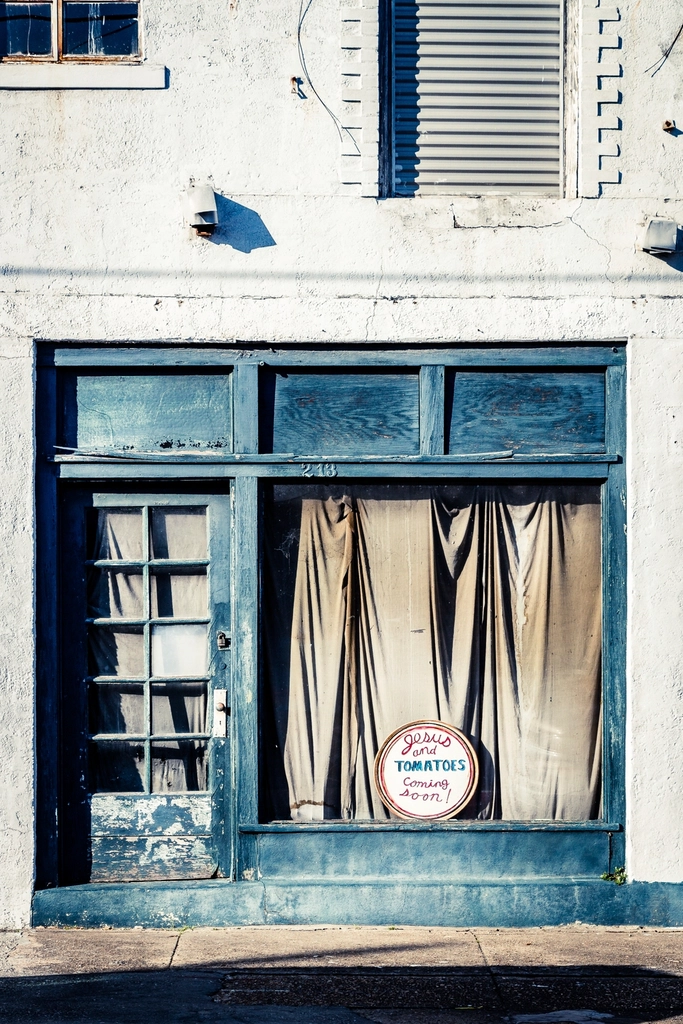
A Sign Taped to the Inside of the Glass
The notice went up on a Tuesday, printed on a sheet of copy paper and taped so it faced out through the window. Thank you for forty-one years. I read it twice standing on the sidewalk with a bag of hardware in my hand, and then I went home and thought about it for two days before I went back and asked whether I could photograph the place before it emptied out.
I have done this maybe a dozen times now in Collierville, and each time I have hesitated first. There is something uncomfortable about showing up with a camera when a family is losing the thing they built. It looks like rubbernecking. But I have also learned that the discomfort is mostly mine, and that most people, when you ask them plainly and early, would rather the place be photographed than not. What they do not want is a stranger standing across the street with a long lens on the last afternoon, making a picture of a sad man carrying boxes to a truck.
Why a Closing Store Looks Different Than an Open One
A working business hides itself. When a shop is running, everything in it is subordinate to the transaction. You do not notice the shelving, the way the light comes through the transom, the forty years of small repairs made with whatever was on hand. You notice what you came in for.
When the inventory starts to go, the building comes forward. Gaps open on the shelves and you see the wall behind them, painted a color nobody has chosen since 1974. The floor shows its wear pattern, a dark path worn from the door to the register to the back counter, which is a map of every customer who ever walked in. Price tags come off and the handwriting underneath is revealed. A closing store is a building briefly telling the truth about itself, and it does that for about a week.
That is the whole argument for making these pictures. Not nostalgia, and not the drama of the ending. It is that a specific kind of information becomes visible for a short period and then is gone permanently, because the next tenant will pull the shelving, paint the walls a neutral gray, and put in recessed lighting.
How I Ask
The ask itself
I ask in person, in the middle of the day, when the store is not busy. I do not lead with the camera. I say who I am, that I live here, that I have shopped here, and that I would like to make a set of pictures of the place before it changes — for the record, not for anything else. Then I stop talking and let them decide.
The single most useful thing I have learned is to ask early rather than late. On the last day, everybody is exhausted and grieving and the shelves are already bare. Two weeks out, the owner still has some energy for it, and the store still looks like a store.
What I promise, and what I do not
I promise three things. That I will stay out of the way of anybody trying to work. That nothing goes anywhere without them seeing it first. That they get files, at full size, for nothing, whatever else happens to the pictures.
I do not promise flattery. I am not making an advertisement for a business that no longer needs one. The pictures are worth something later precisely because they are not staged.
What Is Actually Worth Photographing
My instinct the first few times was to shoot the storefront, the sign, and the owner behind the counter, and then leave. Those are the obvious three. They are also the three that everybody with a phone will take that same week, and they are the least informative.
What I go after now are the systems. Every long-running small business is a private invention, a set of solutions that one person worked out and nobody else on earth uses.
- The workarounds. The register drawer propped with a folded matchbook, the second-hand filing cabinet that holds thirty years of receipts, the door hook made from a bent nail. These are the fingerprints of the people who ran the place, and they are the first things to be thrown out.
- The handwriting. Labels on drawers, a shelf tag corrected in ballpoint, the phone number of a supplier written directly on the wall by the phone. Handwriting dates a place better than any object in it, and it photographs beautifully in flat window light.
- The empty and the full together. A frame that holds one picked-over shelf next to one that has not been touched yet says more about the closing than either alone. That contrast is only there in the middle of the week.
- The back room. Where nobody was ever meant to look. The break table, the calendar from three years ago, the stacked chairs. It is often the most honest room in the building and the one nobody thinks to ask about.
The Owner, and How to Photograph Them
I make a portrait if they will let me, but I try to make it late, after two or three hours of working around them, once the camera has stopped being an event. The good frame is almost never the one where they are looking at me. It is the one where they are doing something with their hands that they have done ten thousand times and will do maybe forty more times.
I have learned to shut up during this. Now I ask one question at the start — how did you end up in this building — and then I let it run and I photograph while they answer. The camera is quieter than my voice.
And there is a limit. If someone starts to cry, I put the camera down. I have never once regretted not making that picture, and I would not want to be the man who made it.
What These Pictures Are Worth Later
Almost nothing, for about five years. Then something changes. A set of interior frames from a shop that closed in 2011 gets asked for by a granddaughter writing something, or by the historical society, or by the man who bought the building and wants to know what was there. Photographs of a business become useful at roughly the moment when everybody who remembers it firsthand starts to be unsure about the details.
I know this because I have been on the other side of it. I have gone looking for pictures of buildings on our square as they were in the 1980s and found nothing but exteriors from across the street. Nobody photographed the inside, because the inside was ordinary, and ordinary is exactly the thing that does not survive on its own.
Keeping Them Where Somebody Can Find Them
A picture that nobody can locate is the same as a picture that was never made. So I do two boring things that matter more than any decision I make with the camera. I caption every frame with the business name, the street address, the room, and the date, typed into the file itself rather than remembered. And I give a small edited set to the Morton Museum and to the family, on physical media, because my hard drives are not a public institution and I will not always be here.
Thirty frames, captioned, in two places, is worth more in the long run than four hundred uncaptioned frames on one drive in my closet.
The Ones I Did Not Get
There is a shoe repair place that closed the year I was busy with other things, and a lunch counter out on the highway that went quietly over a weekend without any notice at all. I have no pictures of either. I know the feel of both rooms and I cannot prove a single thing about them.
That is why I now go when I hear, instead of when I get around to it. A closing is not an event you can schedule around. It has a window of about ten days, and the town only gets one pass at it.