
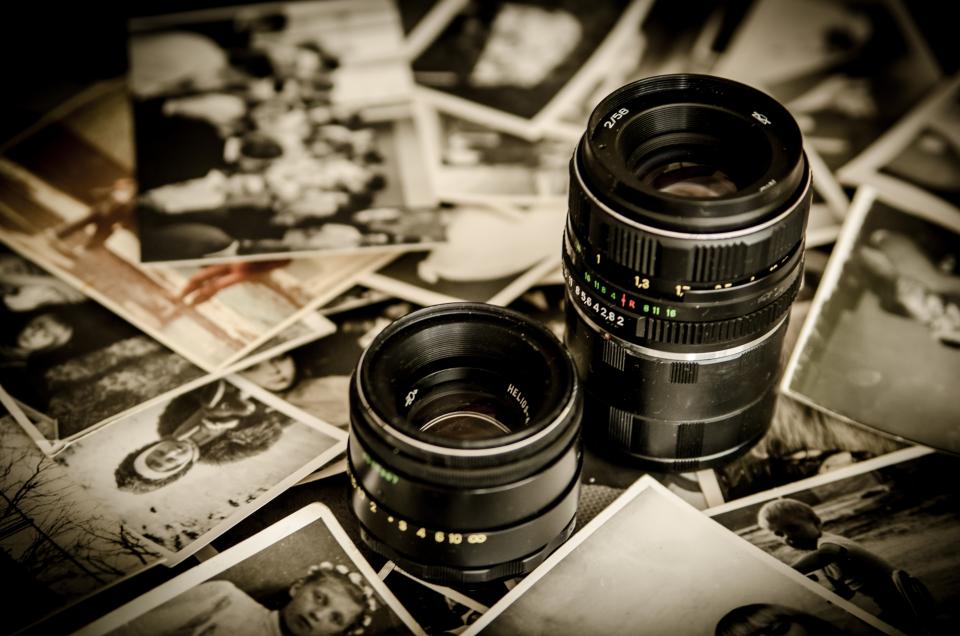
A Box of Prints on a Library Table
The Morton Museum let me spend an afternoon with a box of loose prints, most of them unlabeled, a few with a name and a year in pencil on the back in a hand that was not the photographer’s. I went in expecting to be charmed. I came out unsettled, which turned out to be the more useful reaction, and I have been going back ever since.
What I thought I would find was a picture of the town as it used to be. What I actually found was a picture of what a small number of people in this town, with cameras and a reason to use them, decided was worth the cost of a plate. Those are not remotely the same thing, and the gap between them has changed how I work more than any book of photographs I own.
What the Archive Is Full Of
Buildings, first. A great many buildings, photographed straight on from across the street in flat midday light, usually with the owner and two employees standing stiffly out front. New construction. Storefronts on the day the sign went up. There is an entire genre of photograph here that amounts to proof of investment, made because somebody had just spent money and wanted a record of it.
Then groups. Church picnics, school classes, a baseball team, the men who built something standing on the thing they built. Almost always arranged in rows, almost always outdoors, because indoor light was expensive and slow.
Then trains. The depot and the line through it show up constantly, because the railroad was the reason for the town and because a locomotive was worth photographing in a way that a mule was not.
What all of these have in common is that they were commissioned. Somebody paid. That single economic fact shapes the entire archive.
What Is Missing, and Why That Matters
The ordinary hours
There is essentially no record of a Tuesday. Nobody paid to photograph the walk home from school, the inside of a kitchen at six in the evening, a man sitting on a porch doing nothing, rain on the road. Those hours made up almost the entirety of life here and they are close to invisible.
Weather is missing too. Photographs were made on clear days because clear days were practical. Our summers are humid and heavy and our winters are gray and wet, and you would never guess it from the archive, which appears to depict a town with permanently good light.
The people who were not paying
The harder absence is people. The archive is heavily weighted toward the people who could afford to hire a photographer, and toward the institutions that had a reason to document themselves. Black Collierville is present in the collection, but thinly, and often incidentally — in the background of somebody else’s commission, or in a single group portrait made for a church, rather than across the same range of ordinary occasions.
I do not say that to score a point. I say it because it is a lesson about the mechanics of any archive, including the one I am building right now. An archive is not a record of a place. It is a record of who had a camera, who had money, and what they thought deserved a picture. If I forget that, I will misread everything in the box.
Standing Where the Photographer Stood
I started taking copies of these prints out into town and finding the spots. It is an odd exercise and I recommend it to anyone who photographs one place for a long time.
Some of them are easy. A depot photograph from around 1910 puts you within a few feet, because the building and the track have not moved. Some are impossible, because the reference building is gone and the road has been widened twice. But the act of hunting for the position teaches you things that looking at the print never will.
- They stood farther back than I do. Almost every one of these frames includes more ground and more sky than I would allow. Some of that is lens choice, but a lot of it is that they were photographing a thing in its setting rather than a composition. The setting is the part that turned out to be valuable.
- They shot from eye level, dead on. No angles, no crouching, nothing clever. A century later, the plainness is what makes the picture readable. Every stylistic decision I might have made would now be a layer between the viewer and the information.
- They kept the whole building in. I am forever cropping into a detail because the detail is prettier. The old frames are complete, and completeness is what lets you stand in the right place a hundred years later and know it.
What This Changed in My Own Work
Three things, concretely.
I now make a plain frame in addition to whatever I actually want. If I am photographing a house on Center Street because the light is doing something remarkable on the porch, I also step back and make one boring, straight, whole-building exposure at eye level with everything in it. That second frame is worthless to me and may be the only one that matters in eighty years.
I photograph the unremarkable hours on purpose. Not the square at the tree lighting, which everybody shoots, but the square at two in the afternoon on a wet Thursday in February when there are four cars and nobody outside. That picture is dull today. It is also the picture that does not exist from 1955, and I know exactly how much I would want it.
And I have gotten disciplined about captions. The archive taught me that a beautiful print with nothing on the back is a fraction as useful as an average print with a street, a date, and two names. I write the caption at the time, in the file, in words that would make sense to somebody who never met me.
The Danger of the Old Pictures
There is a trap here and I fell into it for about a year. Once you have spent time in an archive, it becomes very tempting to make photographs that look like the archive — to shoot the pretty old brick, avoid the strip center out on the highway, keep the pickup trucks and the vinyl siding and the drive-through out of the frame. To photograph the town as a period piece.
That is a lie, and worse, it is the same lie the archive already tells, repeated on purpose by somebody who knows better. The people in 1910 were not photographing an old-fashioned town. They were photographing a brand new depot and a brand new store, because those were the exciting things. The equivalent of what they did is not a picture of the same depot. It is a picture of whatever went up on Poplar last year.
Sitting With the Silence
The prints I keep coming back to are the ones where somebody made a mistake. A frame where the shutter caught a boy at the edge, half out, unposed, plainly not the subject. He is the most alive thing in the collection and he was an accident.
I think what the archive really taught me is modesty about my own. Somebody is going to open my files in seventy years and see immediately what I could not bear to photograph and what I did not think was worth the effort. I cannot fix that from here. All I can do is widen the range a little, write things down, and stand back farther than feels natural.