
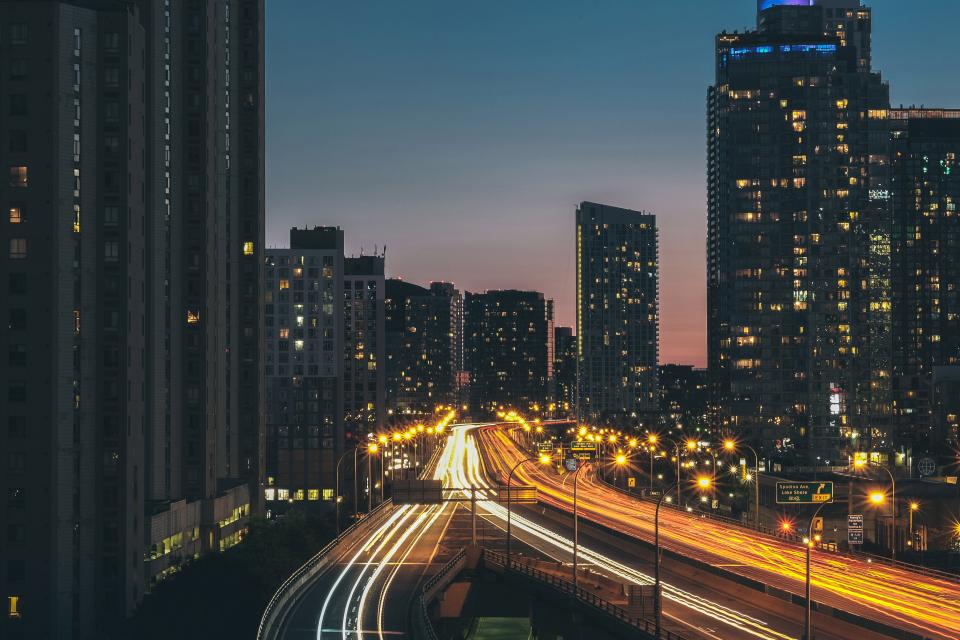
The town changes hands around nine
There is a moment here, usually somewhere between eight thirty and nine, when the town stops belonging to the people who work in it and starts belonging to whoever is still outside. The last customers leave the square. Somebody wheels the sandwich board in off the sidewalk. A truck idles behind the hardware store while a man loads flats of something into the bed, and then he is gone too, and what is left is light on brick and nobody to look at it.
I started photographing at that hour almost by accident. I had gone out to buy a gallon of milk and I had a camera on the seat, which is a habit and not a plan, and on the way back I stopped because the parking lot behind the bank looked like a stage set that had been struck and half re-lit. I stood there for twenty minutes. I made four frames, and three of them were nothing, and one of them I still have. That was two winters ago, and I have gone back out at night maybe sixty or seventy times since.
What follows is not a technique post. I am not going to tell you what to set anything to. This is a record of what I have noticed about a small place after dark, and about what happens to me when I photograph it.
Darkness is not the subject
The first thing I got wrong was assuming that night photography is about darkness. It is not. It is about the very small number of light sources that survive into the evening, and about how strange they are compared to the sun. During the day the whole town is lit by one thing. At night it is lit by maybe two hundred separate things, none of which agree with each other, most of which are pointed straight down.
Once I understood that, I stopped hunting for dark scenes and started hunting for lit ones. A gas station awning is a ceiling of light in the middle of nothing. The window of a laundromat throws a rectangle onto the asphalt with such hard edges you could step over it. A porch light two blocks from the square lights exactly one azalea and one mailbox and stops. Those are the pictures. The dark is just what holds them apart from each other.
This also means I walk differently. In the daytime I look at things. At night I look at where light lands, and then I look at what happens to be standing in it. It is a much smaller search. Some nights the whole town gives me three places worth standing in, and I go to all three, and I come home.
The colors are ridiculous and I have stopped fighting them
Small-town light at night is a mess. The parking lot behind the pharmacy is a hard bluish white that makes everyone look ill. Two streets over there are older fixtures that go orange, a heavy sodium orange that turns the sidewalk into something out of a memory. The sign at the barbecue place is red neon and it bleeds onto everything within fifteen feet of it. The tail lights of a car sitting at the one long light on the main road put a second, moving color into a scene that already had three.
For a while I tried to correct all of this. I would sit with a file afterward and try to talk the greens out of it and drag everything toward something neutral, and what I ended up with was a picture of a town that does not exist. The orange is the town. The green cast under the awning is the town. The thing I was calling an error was actually the most specific fact in the frame.
Now I do very little. I set the overall balance somewhere that makes the largest light source look the way I remember it feeling, and I let the rest fall where it wants. If half the frame goes cold and the other half goes warm, that is not a flaw, that is what it looked like from where I was standing. Nobody who lives here has ever walked past the pharmacy and thought the light was neutral.
Standing still for longer than feels reasonable
Night makes me slow, and the slowness is most of the value. During the day I can raise a camera and lower it in three seconds and move on. At night I have to brace against something. I lean on a light pole, or set the camera on the roof of my own car, or crouch and put my elbows on my knees and stop breathing for a second. Every frame has a little ceremony attached to it.
The ceremony is not free. It costs me things. I miss people walking through, because by the time I am steady they have gone. But it also buys me something: I am in one place, not moving, for two or three minutes at a time, and I see things I would never have seen at walking speed. A moth working the underside of a sign. A cat that came out from under a porch to see what I was, sat down, and then stayed for so long that it became the picture. The way a traffic light cycles for nobody at all, over and over, patient as anything.
I have come to think that the tripod, or the pole, or the car roof, is really a device for keeping me in one spot long enough to notice something. The steadiness is a side benefit.
The problem of being a man standing in the dark with a camera
This is the part nobody warned me about. In daylight, a person with a camera on the square is a hobbyist. At eleven at night, on a residential street, a person with a camera is something else entirely, and I am aware of it every single time I go out.
I have worked out a small set of rules for myself, not because they make good pictures but because they let me keep making them at all. I stay on the sidewalk or in public lots. I do not point at houses in a way that could be read as pointing at windows. If a car slows, I stop what I am doing, stand up straight, and give a wave, because a wave from a stranger is disarming in a way that ducking never is. Twice I have been asked, politely enough, what I was doing. Both times I said I was photographing the light on the building, and both times the person looked at the building, and one of them said he had never noticed it looked like that.
I have also learned to be honest with myself about the difference between shy and sneaky. Early on I was doing a lot of hurrying and half-hiding, and my pictures had that quality in them — grabbed, guilty, badly framed. When I decided to stand out in the open and be visibly a person doing an odd but harmless thing, the pictures got better. Not because of the technique. Because I stopped flinching.
What is actually in these pictures
Almost nobody. That surprised me. I went out expecting to make pictures about loneliness, about the emptied-out American town, all the obvious notes, and I do have some of those and I do not think much of them. The frames I keep are the ones where the town seems to be doing something on its own.
A stack of chairs upside down on a table, seen through glass, with the reflection of the street laid over them. A single mop bucket in a lit hallway behind a locked glass door. Sprinklers going at midnight on the strip of grass in front of the insurance office, throwing light around in a way no one was there to appreciate. The high school parking lot after a game, when it is not empty yet, when there are still eight cars and a lot of noise coming from somewhere you cannot see.
What all of those have in common, I think, is that they are evidence of the daytime town. The chairs are up because someone put them up. The sprinklers run on a timer somebody set. The town at night is full of the recent past, and it is quiet enough that you can read it.
Coming home with three frames
My night take is small. A daytime walk might give me forty exposures and six worth a second look. A night walk gives me eight exposures and maybe two. For a while that ratio bothered me and I tried to pad it, shooting things I did not care about just so the evening felt productive.
I do not do that anymore. The small take is the honest measure of how much there was. And there is a peculiar pleasure in coming back in through the kitchen door at midnight, cold, with two frames I feel good about and a fairly clear memory of standing at the corner where I made them. During the day I photograph faster than I can remember. At night I remember every single one, including where I was standing, including what the air smelled like, including the sound the light made when it cycled. That seems worth the low yield.
If you live somewhere small and you think there is nothing here, go out at ten and look at what is still lit. It is a completely different town. It has been there the whole time, four hours a day, and most of us are asleep for all of it.