
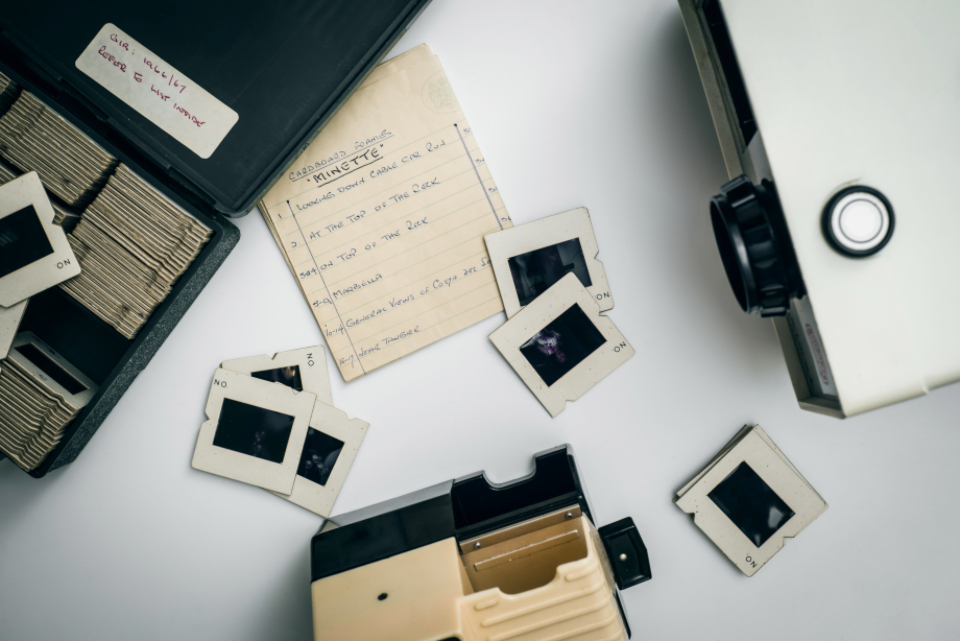
The box I had been avoiding
There is a plastic bin in the closet in the back room with about eleven years of film in it. Sleeved strips, mostly, in binders, with a few loose rolls in envelopes that I never got around to filing. I know roughly what is in there. I had not properly looked at any of it in something like six years.
Last month I pulled it out. Not for any noble reason — I was looking for a lens cap. But the bin was open on the floor, and the light was coming in the window at the right angle, and I picked up a strip and held it up, and that was the rest of the afternoon and then most of a week.
What I want to write about is not nostalgia. Nostalgia is the easy part and it is not very interesting. What I found genuinely startling was how badly I had edited myself the first time through, and what that says about what I was paying attention to back then.
The frames I marked, and the frames I did not
Old me left evidence. There are grease pencil marks on the sleeves, little brackets around the frames I had thought were the keepers. Going through them now, I disagreed with past me constantly, and the pattern in the disagreement was consistent enough that it told me something.
The frames I had marked were, almost without exception, the tidy ones. Clean composition, single clear subject, nothing extraneous. The frames I had skipped were messier, more crowded, more ambiguous, and about half of them are better.
Here is a concrete one. A summer afternoon, a family reunion at a park, sixteen frames. I had marked two: a portrait of a relative against a tree, well lit, well composed, dead as a doorknob. What I had skipped was the frame before it, in which four people are in various states of not being ready, one child is walking out of the edge of the frame, and someone in the background is laughing at something happening off to the right that I no longer have any record of. That frame is alive. Past me looked at it and saw a mistake, because it did not look like a photograph is supposed to look.
Why I chose wrong
I have thought about this a lot and I think there were two reasons, and neither of them was taste.
The first is that I was editing against a template. I had a mental image of what a good photograph looks like, assembled from books and from other people’s work, and I was scanning my own contact sheets for frames that matched it. Anything that did not match got read as a failure. I was not asking whether a frame was interesting, I was asking whether it was correct.
The second reason is more uncomfortable. I was editing for other people. I was picking the frames I could show and get a good reaction to. The messy ones require the viewer to do some work, and I did not trust anyone to do it, including myself. So I picked the ones that announced themselves.
The mark of both problems is the same: I was choosing frames that were finished, and skipping frames that were open. Now I mostly want the open ones. Whether that is progress or just a different taste, I honestly do not know. But it means my archive has been sitting there for a decade holding pictures I did not know I owned.
The frames on either side
The thing negatives give you that a folder of selected files does not is the sequence. You get the whole roll in order, physically attached to itself, and you can see how I arrived at a scene and how I left it.
This has been the most instructive part. There is a roll from a winter morning where I can watch myself get closer to a subject over five frames, and then, on the sixth, back off again, and the fifth frame is by far the best one and I did not use it. There is another where I clearly did not know what I was looking at for three exposures and then suddenly did, and the change is visible: the framing goes from vague to specific between one frame and the next, and you can practically feel the moment I understood.
You cannot see any of this in a folder of ten selected files. The selection erases the process. Sitting with whole rolls, I learned more about how I actually work than I have from any amount of thinking about it. I have a tendency to shoot the establishing shot first and then close in. I almost never take more than seven frames of anything. When I am unsure, I move left. I did not know any of that about myself.
Some pictures had to wait to become good
A handful of frames in that bin have gotten better with nothing changing but time, and that is a strange thing to sit with.
There is one of an intersection out on the east side, made because I liked how the shadow of a sign fell across the road. That was the entire reason. The buildings in the background were just background, and two of them are gone now, and one of them was replaced by something so ordinary that nobody can remember what stood there. The picture is not better as a photograph. But it does something now that it could not do then, and the shadow I cared about is the least interesting thing in it.
There are also portraits of people at ages they will not be again, made casually, with no sense that they were documents. The ones I took seriously are stiff. The ones I threw away a frame on because there was film left on the roll are the ones I now cannot look at without stopping for a minute.
I do not think this means I should photograph everything on the theory that it will matter later. That is a recipe for a hard drive full of nothing. But it has made me gentler about the throwaway frame. The cost of one more exposure is small. The cost of not having it is unknowable from here.
What I actually did with them
I did not want this to turn into a project that lived permanently in the closet, so I set some limits. Over three weeks I went through everything, and I pulled forty-one frames I had never printed. From those I made twelve small prints, and I put six of them in a stack on the desk where I would keep seeing them.
Then I did the part that felt like actual work: I wrote on the back of each one. Where, roughly when, who if I knew, and one line about what I remember. Some of them I could not fill in, and that was a small shock. Eleven years is enough for a place to become unidentifiable to the person who stood there.
I also re-sleeved and labeled everything, which took two evenings and was tedious and is the single most useful thing I have done for the archive. Past me labeled about a third of the sleeves. Future me will not have to guess.
What it changed about this week
Going back through old negatives is often described as a sentimental act and I found it to be a fairly practical one. It gave me a genuine sense of what I was and was not seeing a decade ago, which is not information you can get any other way. Memory will not give it to you honestly.
Two things have changed since. I keep more. When I am culling now and I hit a frame that is messy but has something happening in it, I leave it, because I have direct evidence that my judgment about mess is unreliable and improves with distance.
And I have started leaving myself better notes, because the version of me who opens this bin in another eleven years is going to be a stranger with my handwriting, and he is going to want to know what the light was doing and who that was on the left. The pictures will keep. The context will not, unless I do something about it now.