
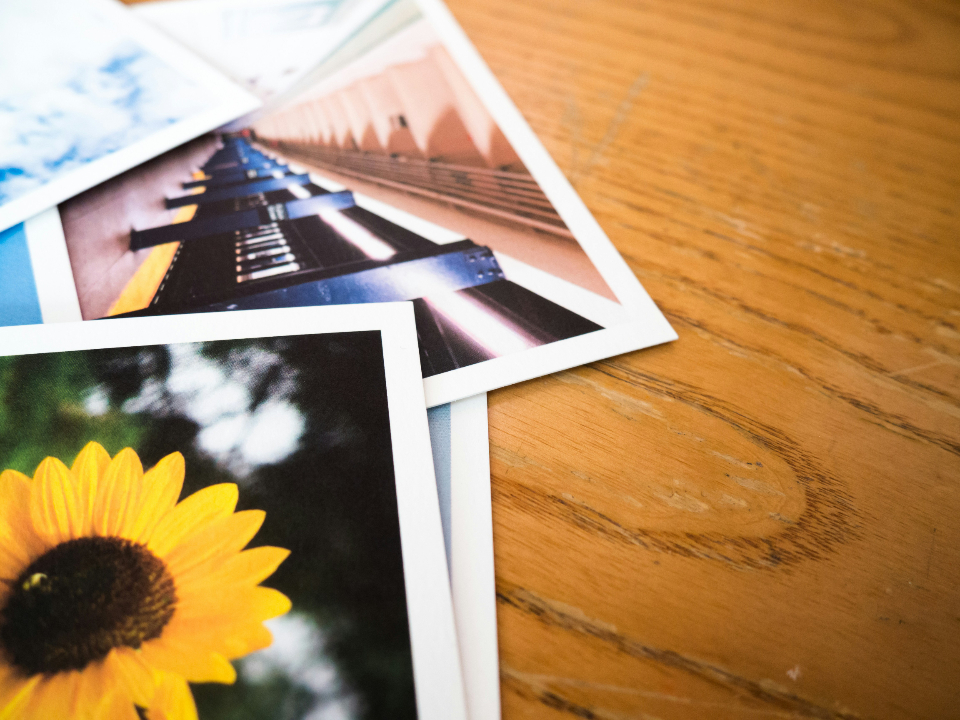
A stack of paper on the kitchen table
For most of the time I have been making photographs, they have existed as light on a screen. I would come home, load the card, spend an evening going through frames, pick the ones I liked, and put a few of them online. Then I would close the laptop and that would be the end of it. Thousands of pictures, none of which I had ever held.
About two years ago I started printing. Not for a show, not to sell anything, not with any plan beyond wanting to see what one of my own pictures looked like as an object. It changed how I photograph more than any other single thing I have done, and it changed it in ways I could not have predicted and would not have believed if somebody had described them to me.
The first batch was humbling
I picked twenty frames I was sure about. Pictures I had looked at many times, that people had said nice things about, that I would have described as my best work.
Maybe five of them survived contact with paper.
The rest fell apart in a way that was immediately obvious and impossible to un-see. A picture that had felt full of atmosphere on the screen turned out to be muddy. A frame I thought was quiet turned out to be empty. Two of them, and this was the worst part, turned out to be soft in a way I had never noticed because I had never looked at them at a size where softness mattered.
The screen had been lying to me, and not maliciously. A backlit image at a certain size on a certain display is a generous medium. It flatters. It adds contrast and life that are not in the file. Everything glows a little. Paper does not glow. Paper gives back exactly what is there, and if what is there is thin, the thinness is the first thing you see.
What a print will not let you get away with
Some specifics, because the general claim is easy to nod along with and the specifics are where it bit me.
- Dead shadows. On screen a dark corner reads as mysterious. On paper it reads as a hole, a place where the picture stops. I now expose and process with a lot more information down there than I used to.
- Busy edges. On a screen your eye stays near the middle. On paper, particularly a larger print, your eye wanders to the corners, and every distraction I had tolerated in the corners announced itself.
- Almost-right framing. A composition that was nearly balanced looked fine at screen size. At print size, the near-miss became the subject. Something being slightly off is much more irritating than something being clearly deliberate.
- Excessive processing. Every adjustment I had made because it looked good at eleven inches looked heavy-handed at sixteen.
None of this is a technical revelation. It is that the print raises the standard and the raised standard is the whole point.
The physical thing has a different weight
Here is the part I find hard to write about without sounding mystical, and I am going to try anyway.
A print sits still. That is the essential difference. An image on a screen is one of a hundred you are going to look at in the next four minutes. It has neighbors. It has an implied next, and the next is always available, and your attention knows this and never fully commits. You look at a photograph online for something like two seconds.
A print on a table demands to be picked up. There is nothing after it. You look at it for as long as you look at it, which turns out to be much longer, and in that longer looking you find things. I have discovered details in my own photographs, my own, that I made and processed and posted, only after seeing them printed. A reflection in a window. A second person in the background whose posture completely reframes what the picture is about.
Somebody handed one of my prints back to me at a kitchen table and said something about it that I had not seen, and I had to hold it and look for a while before I understood what they meant. You cannot have that conversation over a phone screen. The object gives people permission to spend time.
Printing changed what I look for
This is the effect that reached backward into the photography itself, and it was gradual enough that I did not notice it happening.
I started, without deciding to, making pictures with more information in them. More tonal range, more detail in the quiet areas, fewer frames that depended on one dramatic gesture. A picture that hits you instantly is great online, where instant is all you get. A picture that rewards two minutes is a different animal, and once I had spent a year looking at prints I started, involuntarily, hunting for the second kind.
I also got much more ruthless in editing. When the end of the process was a post, the cost of including a mediocre picture was nothing. When the end is paper and ink and forty minutes, you ask a harder question about every frame: is this worth making real. Most are not. That question has quietly cut my output by about two thirds and improved it by considerably more than that.
And I have become interested in sequence in a way I never was. Prints spread on a table can be moved. You put two next to each other and they change each other. I have spent whole evenings just rearranging fifteen prints, and it has taught me more about how photographs relate to one another than years of scrolling ever did.
The unglamorous practical parts
I am not going to turn this into a gear discussion, but a few honest notes, because I wasted time on things nobody told me.
Paper matters far more than I assumed and the difference is not subtle. The same file on a smooth bright surface and on a warm textured one are two different photographs, with different emotional temperatures. I went through a lot of paper figuring out that I like a matte warm surface for almost everything I do and that this is a preference, not a fact.
Getting the screen and the print to agree is tedious and it is the entire game. For months I fought this and blamed the printer. The printer was fine. My screen was too bright, which meant every print came out dark, which meant I kept lifting files that did not need lifting. Turning the screen brightness down fixed most of it in an afternoon.
You will waste paper. I made a whole box of prints in the first six months that went in the recycling. That was not failure, it was the cost of learning, and I only wish I had accepted it faster instead of agonizing over each sheet.
And you do not need to own a printer. My first year I sent files out to a lab. That is cheaper to start, the quality is good, and the slow turnaround has an underrated benefit: you cannot fiddle. You commit, you wait a week, and you receive a verdict.
Where the prints live now
Most of them are in two archival boxes on a shelf, which is not romantic but is the truth. A dozen are framed around the house. Some have been given away, which I have come to think is the actual point of the whole exercise.
Giving somebody a photograph of themselves, on paper, is a strange and disproportionately large thing. I gave a print to the man who runs the shop where I get my coffee, a frame of him leaning on the counter in the morning light, and he put it up by the register, and it has now been there for over a year. Thousands of people have walked past it. That photograph has had a longer and fuller life than anything I have ever posted.
Nothing about the file changed. It was the same picture the whole time, sitting on a drive. Making it into a thing you can hold is what let it go out and do something in the world, and I did not understand that until I had a stack of paper on the kitchen table and had to decide what to do with it.