
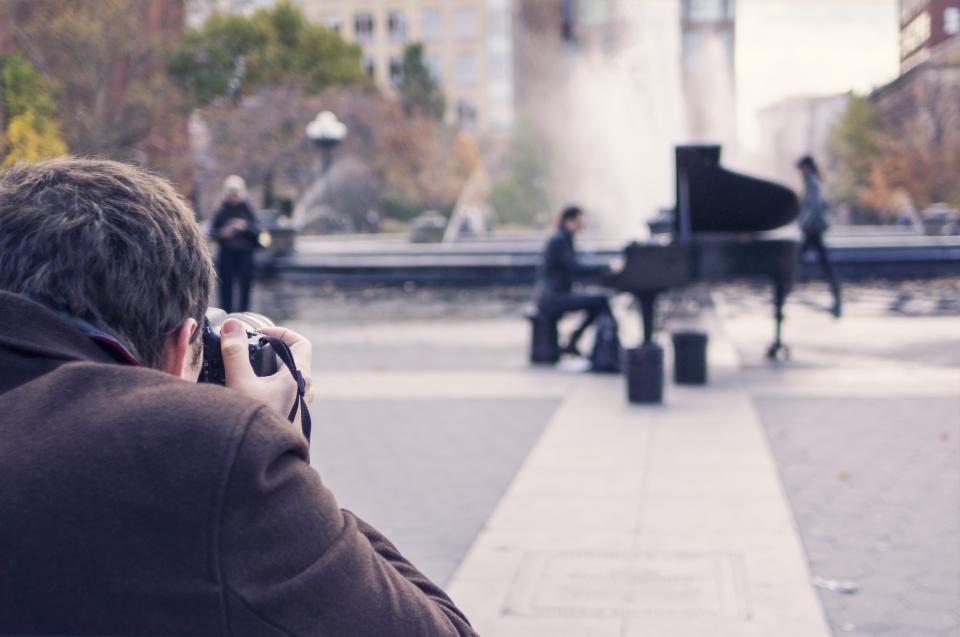
The forty seconds before the picture
The hardest part of making a portrait of somebody I do not know has never been the light or the framing or the settings. It is the walk over, and the sentence I say when I get there.
I have been doing this for a few years and I am still not good at it. I am better than I was, mostly because I have failed enough times to have some idea of what does not work. What I want to write down here is what actually happens in those forty seconds, because most of what I read about street portraits skips straight from “see the person” to “make the exposure,” and the entire difficulty lives in the gap.
Why I ask at all
There is a real tradition of not asking, and some of the photographs I love most were clearly made without a word exchanged. I am not going to pretend the candid frame and the asked-for frame are the same thing, because they are not. Something goes out of a face the moment it knows it is being looked at, and the thing that comes in to replace it is a performance, even when the performance is sincere.
So why ask? Partly because I could not live with myself otherwise, in the specific sense that I do not want to be the guy who takes something from a stranger and walks away. That is a personal line and I am not proposing it as a universal one.
But there is also a working reason. When I ask, I get access to a different set of pictures. I get to stay. I get to say “would you mind turning a little toward the door” and have it happen. I get four minutes instead of one frame. The candid picture and the asked-for picture are competing possibilities, and once you understand that you are choosing between them rather than doing the same thing two ways, the choice gets easier.
Mostly I ask because I want to know who I am photographing. That has become more important to me than the pictures.
What I have learned to say
The first thing is that I never open with the camera. If the first sentence is about the camera, the whole encounter is about the camera, and the camera is the least interesting thing present.
I open with the reason. Not a compliment, a reason. “I have been walking around taking pictures this afternoon and the light coming off that wall behind you is the best thing I have seen all day.” That is true, it is specific, and it makes clear immediately that I have been paying attention to something. People can tell the difference between an observation and a line.
The second thing is that I say what I am doing and where it goes. “I keep a little site where I put these, mostly just for myself.” That is short and it is honest and it heads off the question everybody is actually thinking, which is: what happens to this picture of me.
The third thing, and this took me the longest to learn, is that I ask a real question and then I stop talking. Not “is it okay if I grab a quick shot,” which is a question shaped like an apology and invites a no. Just “would you let me make a portrait of you?” And then silence. The silence is unbearable for about two seconds and then it does its work. If I fill it, I have taken the decision away from them and made it about my nervousness.
The no, and how to take it
Maybe one in three says no. In some neighborhoods and at some hours it is higher, and that is entirely reasonable.
What I have learned is that the no needs to be as easy for them as the yes. If somebody hesitates, I say “no problem at all” before they have to find the words, and I mean it, and I keep walking. The worst thing you can do, and I have done it, is to make one more case. “It will only take a second.” That sentence turns a person’s boundary into an obstacle you are negotiating around, and even if they cave, you have taken something that was not offered.
The other thing about the no: it does not mean anything about you. I spent a lot of my first year taking rejections personally and it made me hesitant, which made me approach badly, which got me more rejections. People say no because they are late, because they look tired and know it, because their kid is having a meltdown in the next aisle, because a stranger asking for something is a lot to process on a Tuesday. Almost none of it is about you and your camera.
The awkward middle
Say they said yes. This is where I used to fall apart.
What happens is that both of you now have a job and neither of you knows how to do it. They stand up straight, put their hands somewhere strange, and produce the face they use for driver’s license photographs. And I get flustered and start shooting immediately, which means I am making frames of a person doing their impression of somebody being photographed.
What helps is talking. Not directing. Talking. I ask them something and I listen to the answer, and while they are answering I am working. The face does something entirely different when it is engaged in explaining a thing than when it is being photographed. Ask a person about their work, about the dog, about how long they have been coming to this place. There is a particular moment about thirty seconds in where they forget the camera for a beat, and that beat is almost always the frame.
The other thing that helps is admitting the awkwardness out loud. “This is the weird part, just give me a second.” It breaks the tension because it names it, and because it puts me in the awkwardness with them instead of on the comfortable side of the lens.
I also try to say when I have got it. “That is the one, thank you.” People want to know they can stop. Letting somebody stand there wondering whether they are doing it right is unkind, and it also produces bad pictures.
Afterward
I ask if they want to see, and I show them one on the back of the camera. Not all of them, one. Showing everything invites a critique session and puts them in the position of judging their own face, which nobody enjoys.
If they want it, I take an email or a number and I send it. I have gotten better about actually doing this. For a while I was collecting addresses with genuine intentions and then letting a week go by and then feeling too embarrassed by the delay to send it at all, which is a stupid and small failure but a real one. Now I send it that night, before I have looked at anything else.
A woman at the hardware store last fall told me she had not had a picture taken of herself in nine years, since her husband died, because he had been the one who took them. I sent her three frames and she wrote back that she had printed one for her daughter. I think about that more than I think about any photograph I made that year.
What the asking has done to me
I did not expect this to change anything except my hit rate. It has changed more than that.
The main thing is that I am a better looker now, because looking has consequences. When there is a chance I am going to walk over and speak to somebody, I stop scanning and start actually seeing, because I need a reason and the reason has to be true. That has made me slower and considerably more attentive.
The other thing is smaller and harder to say without sounding sentimental. I know a few dozen people in this town now that I would not otherwise know. The barber who does not cut hair anymore but still comes in on Saturdays. The couple who run the stand at the farmers market and argue constantly and affectionately about tomatoes. Not friends, exactly. But not strangers.
The camera got me through the door, and the asking is the door. If I had spent those years working quietly from across the street I would have more pictures and I would know nobody, and I am fairly sure the pictures would be worse.