
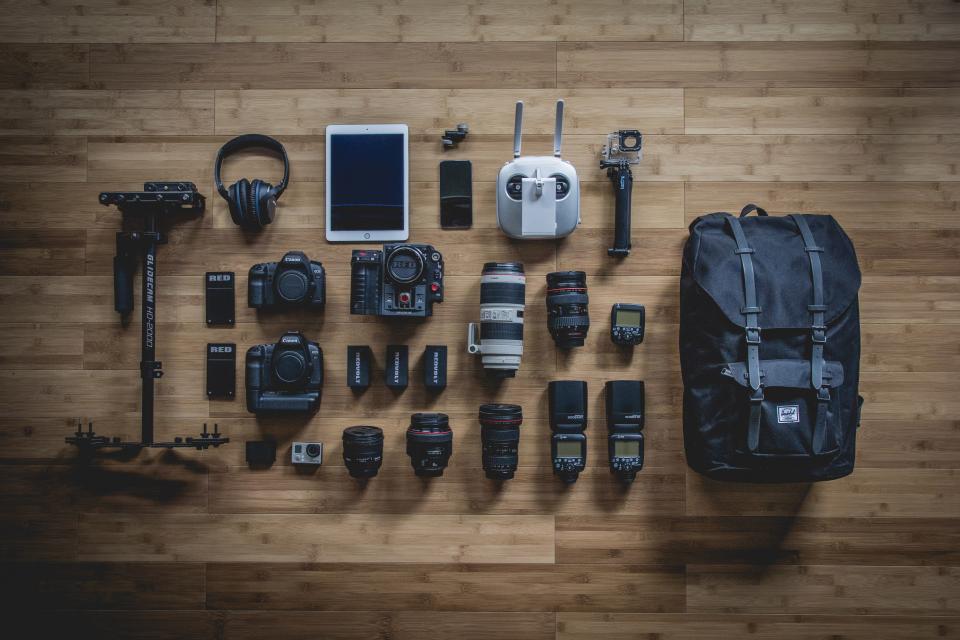
What is in there this morning
The bag is a canvas shoulder bag, unlined, with one main compartment and a pocket on the front that does not close properly anymore. It was not sold as a camera bag. It cost me almost nothing at a shop two towns over about six years ago and I have carried it nearly every day since.
Inside it right now: one camera with one lens on it, a spare battery, a lens cloth that needs washing, a folded plastic grocery bag, a small notebook, a pen that works, a second pen that does not, two receipts, and a paperback. That is the whole thing. It weighs about as much as a full grocery bag and I stop noticing it after about ten minutes.
I am writing this down not because the contents are interesting but because it took me a long time to arrive at them, and the road there was expensive and a little embarrassing.
The camera, and why it stays the same
I have used the same body for years. It is not the newest, it was not the best when I bought it, and if you handed me a better one I would probably be a slightly worse photographer for about a month.
That is the actual argument for staying put, and it is not a moral one. It is about the hands. I can change the settings on this camera without looking at it, in the dark, in gloves, walking. When something happens in front of me the delay between seeing it and being ready is close to nothing. That gap is where photographs die. Every time I have switched equipment, the gap has reopened, and for weeks afterward I have been half a second behind the world.
I do not think the body matters much beyond that. What matters is that it is one body, that it is the same one, and that I have stopped thinking about it. The moment I start thinking about the camera again, I am no longer looking at the street.
One lens, most days
There is a longer lens at home in a drawer. It comes out perhaps six times a year, and honestly four of those are for the school field.
What I carry is a moderately wide prime that is a little wider than what my eye feels like it does. That mismatch used to bother me and now I think it is the point. It forces me close. I cannot stand across the street and take something politely from a distance; I have to be near enough that the person could talk to me, which changes the photograph and also changes me, because it means I am participating in the situation rather than harvesting it.
The other benefit of one lens is that framing stops being a decision. I know what will be in the picture before I lift the camera, roughly, because I have made about ten thousand frames at that focal length. Walking down the sidewalk I am already seeing in that shape. When I carried three lenses I spent a lot of the walk deciding, and deciding is not seeing.
I am not claiming this is universal. Someone who photographs birds would find all of this useless. But for what I do, which is walk around a small town looking at ordinary things, the constraint has been worth far more than the flexibility ever was.
The things that are not photographic
The notebook earns its place more than any accessory I have ever owned. Half of what I put in it is not about pictures: a name I want to remember, the fact that the barber is closing in November, a sentence I overheard at the counter. But the other half is a list of things to go back for. The pecan tree on the corner lot with the light on it around five. The garage with the two hand-painted numbers. Almost every photograph I have made deliberately, rather than by luck, started as a line in that notebook weeks earlier.
The plastic bag is for rain, obviously, and it has saved the camera twice.
The paperback is the item I would defend hardest and the one that makes the least sense. It is there so that when nothing is happening, I have permission to stop. Before I started carrying a book I used to fill dead time by taking bad photographs, because holding a camera and doing nothing felt like failure. Now I sit on the bench by the post office and read for twenty minutes, and I look up occasionally, and I am oddly more likely to see something than I was when I was prowling around trying to force it.
What I removed, and what came back
The bag used to be much heavier. Here is what left it and did not return:
- A second body. I wrote about giving that up already; the short version is that carrying two meant I chose neither.
- Two extra lenses, a wide and a long, which between them accounted for maybe one percent of my frames and one hundred percent of my shoulder pain.
- A tripod, which I carried for a whole year and used four times, all four of them badly.
- A set of filters I did not understand and never learned.
Two things did come back after I cut them. The spare battery, because I lost an entire good evening once being clever about weight. And the lens cloth, because the smear on the glass is the most common way I ruin a day’s work and I cannot see it until I am home.
The general shape of the lesson is that the things worth carrying are the ones that prevent total losses, not the ones that promise additional pictures. A battery prevents a loss. A third lens promises a picture. The promises almost never pay.
The bag as a decision made in advance
Here is what I did not expect. The main thing the bag does is not carry equipment. It removes decisions from the street.
When I step out the door, every choice about what to photograph with has already been made, days or years ago, and made calmly at a kitchen table rather than badly in the middle of a moment. Out on the sidewalk I am left with one question, which is what to point it at. That is the only question worth having, and for years I was cluttering it up with four or five others that were all really about anxiety.
Packing lighter also changed how far I go. With the heavy bag I would drive somewhere, because it was too much to just carry around. With this one I walk out of the house without thinking about it, most evenings, sometimes only for fifteen minutes. That frequency has done more for my work than any piece of equipment I have ever bought. Small, constant, unplanned time in the same few streets is where nearly everything I care about has come from.
What lightness actually buys
I want to be careful not to make this sound like a virtue. There is nothing noble about carrying less. Plenty of people I admire carry a great deal and use all of it, and if I photographed differently I would need more.
What lightness bought me specifically is willingness. The bag is light enough that going out is never a project. It never requires a decision about whether today is worth it. It just goes over my shoulder on the way to the mailbox, and about one time in eight, something happens on the way to the mailbox.
That is the whole return. Not better photographs on any given day — probably slightly worse ones, if I am honest, since I have given up options. But many more days. And in a practice that is mostly about being present often enough for the ordinary to reveal itself, the number of days is the thing that compounds.